
✔ Advanced, science-based interpretation of canine communication, stress signals, and behavioural sequences.
✔ Professional-level observation skills focused on early detection, safety, and welfare-centred understanding.
✔ In-depth preparation for advanced behaviour analysis and modification in Level 3.
£89.99
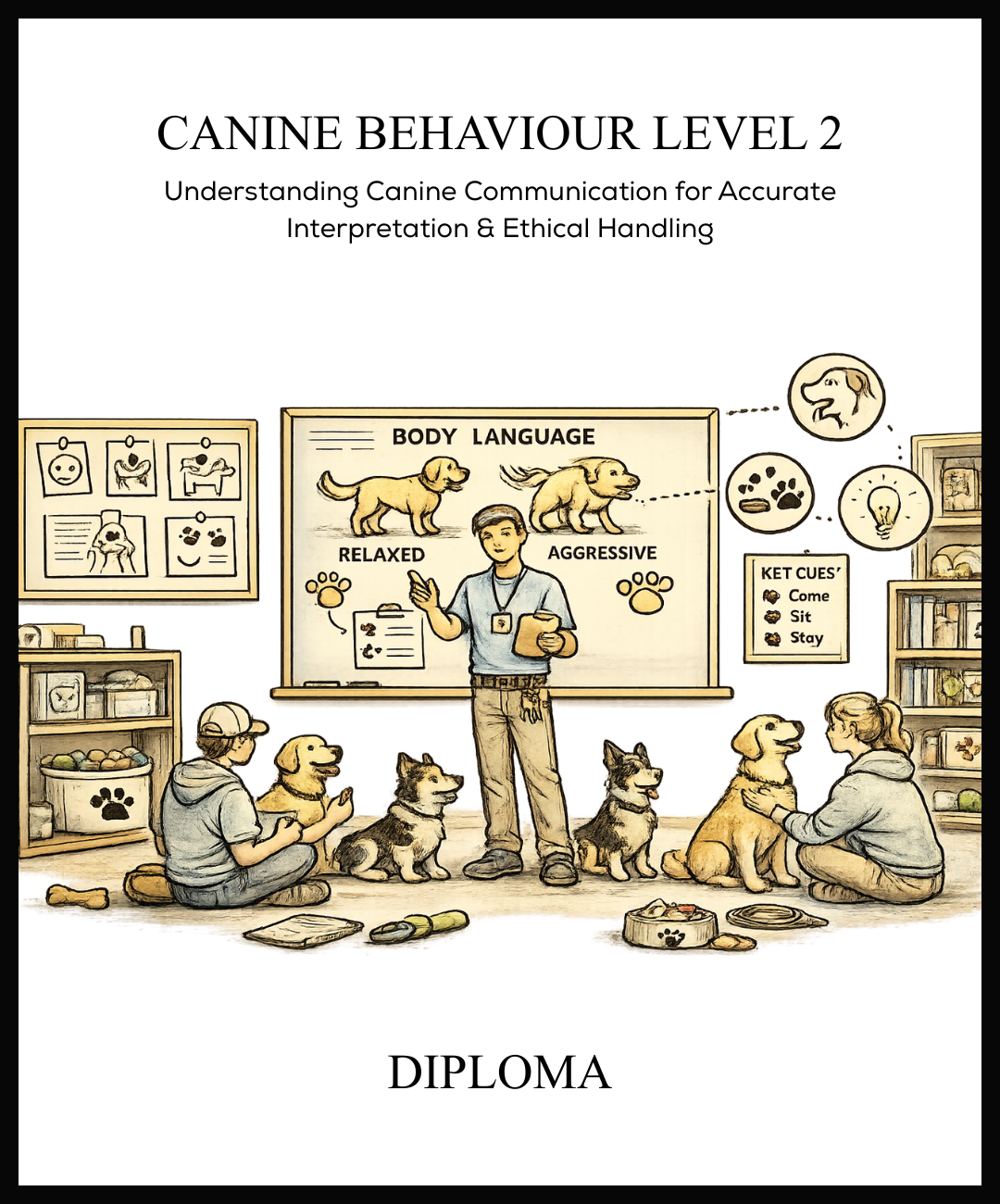
Canine Body Language & Communication – Level 2 is an advanced, in-depth course designed for learners who already understand basic canine communication and body language principles. This course moves far beyond surface-level signals, developing the skills needed to accurately interpret subtle, complex, and high-risk communication patterns before behaviour escalates.
Across ten intensive modules, learners explore canine communication as a dynamic, sequential system shaped by evolution, physiology, emotion, learning history, and environmental context. The course focuses on advanced observation, precise terminology, behavioural sequencing, stress physiology, displacement and conflict behaviours, social signalling, and the earliest precursors to fear, stress, and aggression.
Drawing on modern ethology, veterinary behaviour medicine, and contemporary behaviour science, this course replaces simplified “signal lists” with professional-level frameworks used by experienced behaviour practitioners. Learners are taught to read behaviour as a flowing sequence rather than isolated gestures, improving accuracy, safety, and welfare outcomes.
This is the second course in the three-level behaviour pathway and prepares learners for Level 3, where full behaviour analysis and modification strategies are introduced. Delivered via online distance learning, the course can be completed at your own pace and is suitable for serious learners seeking depth, precision, and professional competence.
Canine Body Language & Communication – Level 2 is designed for learners who already have foundational knowledge of canine behaviour and want to develop advanced interpretation skills.
It is ideal for:
Dog trainers and behaviour practitioners
Dog walkers, daycare staff, and kennel professionals
Rescue workers and foster carers managing complex dogs
Veterinary nurses and animal care professionals
Students progressing toward advanced behaviour study
This course is not suitable for complete beginners. A basic understanding of canine body language and behaviour theory (Level 1 or equivalent) is strongly recommended.
By the end of this Level 2 course, learners will be able to:
Conduct advanced behavioural observation using ethological frameworks
Identify subtle stress signals and micro-warnings before escalation
Interpret displacement and conflict behaviours accurately
Analyse play behaviour and recognise early deterioration into conflict
Distinguish emotional states from motivational systems
Read behaviour as a sequence rather than isolated signals
Interpret dog–dog and dog–human communication with contextual accuracy
Recognise early precursors to fear, stress, and aggression
Produce structured, professional-quality behaviour observations and reports
Understand the boundaries between interpretation (Level 2) and modification (Level 3)
Learners complete the course with professional-grade observational skills and a deeper, safer understanding of canine communication.
Module One: The Science of Communication – Signal Systems, Social Function & Evolution
Understanding communication as an evolved, ritualised system shaped by emotion, motivation, and context.
Module Two: Stress Communication – Micro-Signals & Bio-Behavioural Responses
Identifying subtle stress indicators, physiological responses, and early escalation patterns.
Module Three: Displacement Behaviours & Conflict Indicators
Understanding motivational ambivalence, displacement, and early conflict communication.
Module Four: Play – Ethograms, Emotional States & Social Negotiation
Analysing play structure, reciprocity, self-handicapping, and early deterioration.
Module Five: Social Communication Between Dogs
Greeting rituals, social tolerance, pressure signals, and silent conflict indicators.
Module Six: Human–Dog Communication (Advanced Interpretation)
Understanding miscommunication, touch sensitivity, human social pressure, and consent.
Module Seven: Early Indicators of Fear, Stress & Aggression
Micro-warnings, thresholds, distance management, and escalation sequences.
Module Eight: Whole-Dog Assessment & Contextual Interpretation
Full-body analysis, environmental load, and pattern recognition.
Module Nine: Multi-Dog Households & Group Dynamics
Social facilitation, silent conflict, and managing complex group interactions.
Module Ten: Practical Observation Skills & Ethogram Use
Professional observation tools, pattern tracking, video analysis, and reporting.