
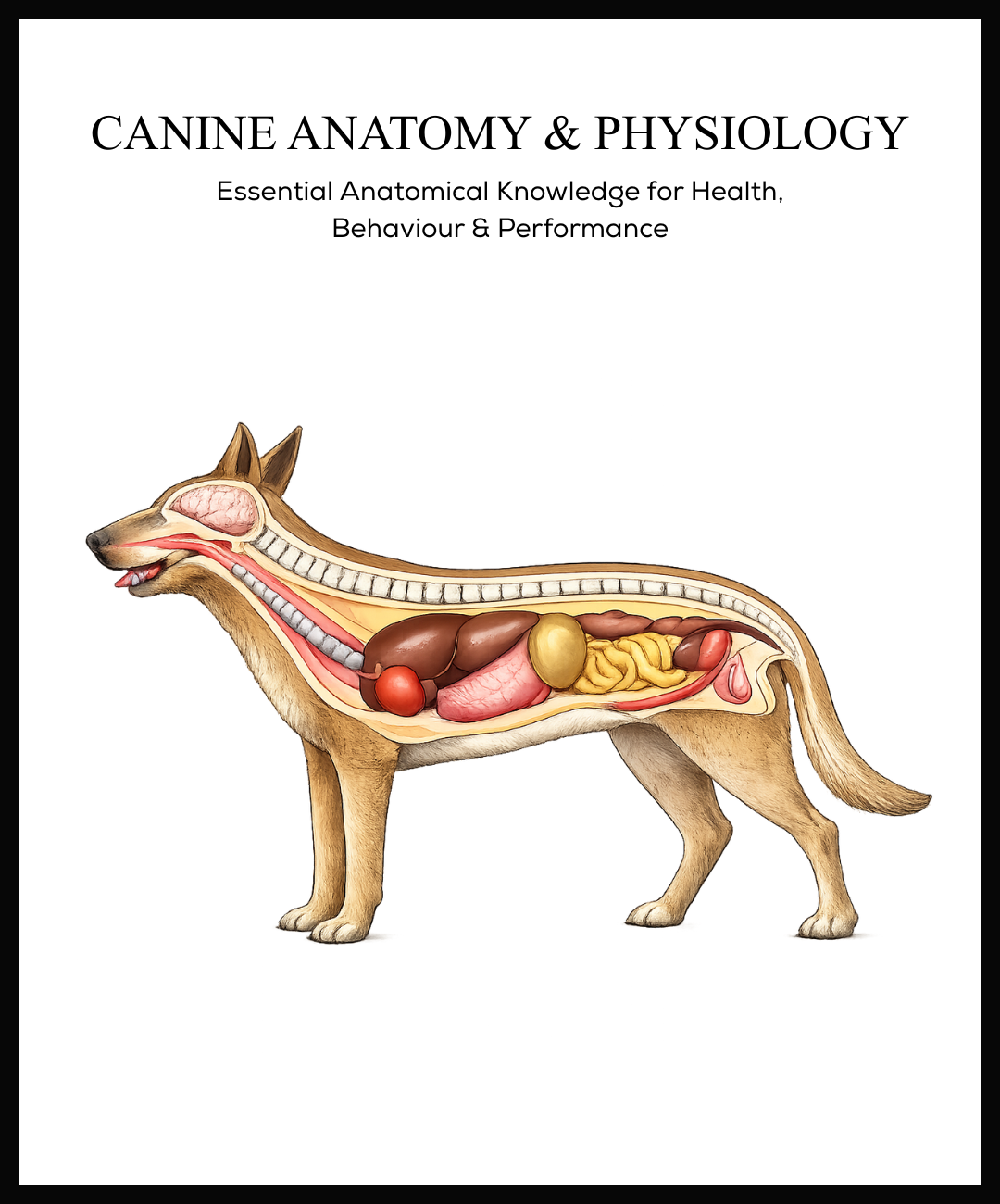
✔ In-depth, science-based understanding of canine anatomy, physiology, and metabolism as integrated systems.
✔ Clear links between internal structure and real-world outcomes such as behaviour, movement, stress tolerance, and ageing.
✔ Welfare-focused education designed to support proactive, responsible, and biologically informed canine care.
£79.99
Canine Anatomy, Structure & Metabolism: Understanding the Dog From the Inside Out is a comprehensive, in-depth course designed to provide a clear, functional understanding of how the canine body is built, how its systems operate, and how structure and metabolism influence health, behaviour, resilience, and disease.
Rather than treating anatomy as a memorisation exercise, this course presents the dog as an integrated biological system, where movement, digestion, circulation, respiration, nervous function, immunity, and emotional regulation are inseparably linked. Learners are guided to understand not just what each system does, but why it matters in real-world care, training, management, and welfare decisions.
Across ten detailed modules, the course explores all major anatomical and physiological systems, continually linking internal structure to practical outcomes such as exercise tolerance, injury risk, stress resilience, ageing, behavioural change, nutrition, recovery, and long-term wellbeing. Strong emphasis is placed on system interaction, adaptation, and functional health rather than clinical diagnosis.
Written for dog owners and professionals alike, the course is academically grounded yet accessible, replacing assumptions with biological understanding. It supports informed, proactive care by helping learners recognise early signs of imbalance and make decisions that align with canine biological reality.
Delivered through online distance learning, the course is fully written, self-paced, and suitable for both personal education and professional development.
Canine Anatomy, Structure & Metabolism is designed for anyone who wants a deeper, more accurate understanding of how dogs function physically.
It is ideal for:
Dog owners seeking informed, welfare-led care
Trainers and behaviour professionals
Kennel, rescue, and boarding staff
Holistic and integrative practitioners
Students of canine science, welfare, or management
Anyone working with dogs in a professional capacity
No prior anatomical knowledge is required. Concepts are explained clearly and built progressively throughout the course.
By the end of this course, learners will be able to:
Understand the structure and function of all major canine body systems
Explain how anatomy influences movement, digestion, behaviour, and resilience
Recognise how systems interact rather than operate independently
Apply anatomical understanding to everyday care decisions
Identify early functional signs of stress, imbalance, or compromise
Support dogs more responsibly across different life stages
Learners finish the course with the biological literacy needed to care for dogs with greater confidence, insight, and ethical responsibility.
Module One: Foundations of Canine Anatomy & Biological Organisation
Understanding anatomy, physiology, homeostasis, system interaction, and structural variation.
Module Two: The Digestive System & Metabolism
Digestion, nutrient absorption, microbiome function, metabolism, and links to immunity and behaviour.
Module Three: Cardiovascular, Lymphatic & Endocrine Systems
Transport, immune defence, hormonal regulation, stress response, and recovery.
Module Four: The Locomotory System – Bones, Joints & Muscles
Movement mechanics, load management, injury prevention, and longevity.
Module Five: The Nervous & Respiratory Systems
Control, communication, oxygenation, emotional regulation, and performance.
Module Six: Reproductive & Excretory Systems
Hormonal balance, waste elimination, internal regulation, and ethical considerations.
Module Seven: Skin, Ears & Eyes – Protective & Sensory Systems
Barrier protection, sensory perception, communication, and environmental sensitivity.
Module Eight: System Integration & Functional Health
Whole-body interaction, stress load, resilience, and pattern recognition.
Module Nine: Ageing, Adaptation & Structural Change
Development, maintenance, decline, and lifespan-appropriate care.
Module Ten: Applying Anatomical Knowledge to Canine Care
Using anatomy to guide feeding, exercise, handling, enrichment, and prevention.