
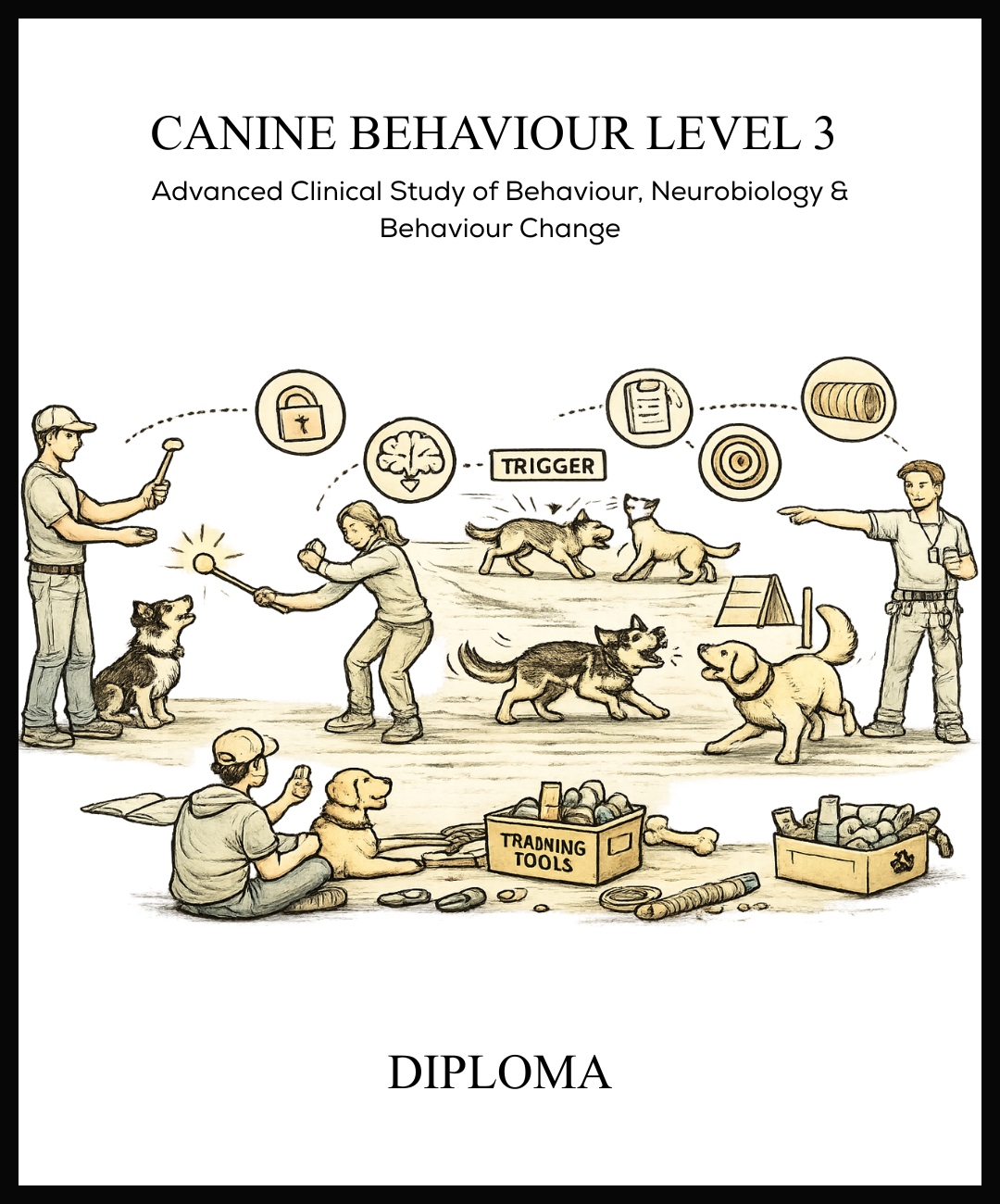
✔ Advanced, diploma-level training focused on behaviour analysis, case assessment, and ethical behaviour modification.
✔ Strong emphasis on welfare, safety, professional boundaries, and evidence-based practice.
✔ Designed to prepare learners for real-world behaviour work with complex and high-risk cases.
£199.99
Level 3: Clinical Canine Behaviour, Neurobiology & Behaviour Change is an advanced, diploma-level course designed for learners who want to understand canine behaviour at its deepest level — where neurobiology, emotion, learning, welfare, and environment intersect. This course moves beyond surface behaviour and into the biological and emotional systems that drive fear, aggression, anxiety, compulsive behaviour, and resilience.
Across ten in-depth modules, learners explore how the canine brain creates behaviour through affective systems, neurochemistry, stress physiology, pain processing, learning mechanisms, and emotional regulation. The course provides a clinical framework for assessing complex behaviour cases, identifying underlying drivers, and designing ethical, evidence-based behaviour modification plans within appropriate professional scope.
Strong emphasis is placed on affective neuroscience, functional behavioural analysis, clinical case history taking, risk assessment, and ethical practice. Learners are taught how to integrate medical, neurological, environmental, emotional, and learning factors into coherent behaviour plans, while working responsibly alongside veterinary professionals and multidisciplinary teams.
This course is academically demanding and information-dense. It is designed for serious learners seeking professional-level understanding rather than quick-fix training solutions. Delivered via online distance learning, it combines detailed written content, case studies, worksheets, protocols, and reflective practice to support deep learning and real-world application.
Level 3: Clinical Canine Behaviour, Neurobiology & Behaviour Change is designed for experienced learners who already have a solid foundation in canine behaviour and communication.
It is ideal for:
Advanced canine behaviour students and practitioners
Experienced dog trainers transitioning into behaviour work
Behaviour professionals working with fear, aggression, anxiety, or compulsive cases
Professionals seeking a neurobiological and clinical understanding of behaviour
Learners preparing for multidisciplinary or referral-based behaviour practice
This course is not suitable for beginners. Prior study in canine behaviour, learning theory, and body language (Level 1 and Level 2 or equivalent) is strongly recommended.
By the end of this Level 3 course, learners will be able to:
Explain how neurobiology, affective systems, and neurochemistry drive canine behaviour
Interpret behaviour through emotional systems such as SEEKING, FEAR, RAGE, PANIC/GRIEF, PLAY, and CARE
Conduct thorough, clinical-style behaviour assessments and case histories
Distinguish behavioural issues from medical, neurological, pain-related, and sensory conditions
Apply functional behavioural analysis to identify the true drivers of behaviour
Design ethical, welfare-focused behaviour modification plans
Apply advanced learning theory, including desensitisation, counterconditioning, differential reinforcement, and errorless learning
Assess risk, manage safety, and work within professional scope
Collaborate appropriately with veterinary professionals and multidisciplinary teams
Document, evaluate, and reflect on behaviour cases using professional standards
Graduates leave the course able to analyse and manage complex behaviour cases with depth, precision, and ethical responsibility.
Module One: Advanced Canine Neurobiology & Affective Systems
Brain structures, emotional systems, neurochemistry, stress physiology, pain, neuroplasticity, and how brain function creates behaviour.
Module Two: Clinical Behaviour Assessment & Case History Taking
Structured clinical interviews, differential analysis, observation tools, red flags, and scope-of-practice decision-making.
Module Three: Ethics, Welfare & Professional Boundaries
LIMA principles, consent, safeguarding, aversive fallout, referral processes, and professional responsibility.
Module Four: Advanced Learning Theory & Behaviour-Change Technology
Differential reinforcement, counterconditioning, stimulus control, errorless learning, habit formation, and relapse prevention.
Module Five: Treatment of Fear, Phobias & Generalised Anxiety
Advanced assessment and behaviour modification frameworks for fear-based and trauma-related behaviour.
Module Six: Aggression – Functional Analysis & Behaviour Modification
Risk assessment, aggression classification, functional analysis, safety planning, and ethical intervention strategies.
Module Seven: Compulsive, Stereotypic & Impulse-Control Disorders
Neurobiological drivers, assessment, environmental redesign, and supportive intervention planning.
Module Eight: Multi-Dog Households & Group Dynamics
Social relationships, conflict prevention, management strategies, and ethical decision-making.
Module Nine: Medical, Cognitive & Age-Related Behaviour Problems
Pain, neurological conditions, cognitive decline, and integrating medical factors into behaviour plans.
Module Ten: Behaviour Case Management & Professional Practice
Case structure, reporting, progress evaluation, collaboration, reflective practice, and professional development.